Song Health—A plan for America
- B. Way

- 3 days ago
- 6 min read
Updated: 1 day ago
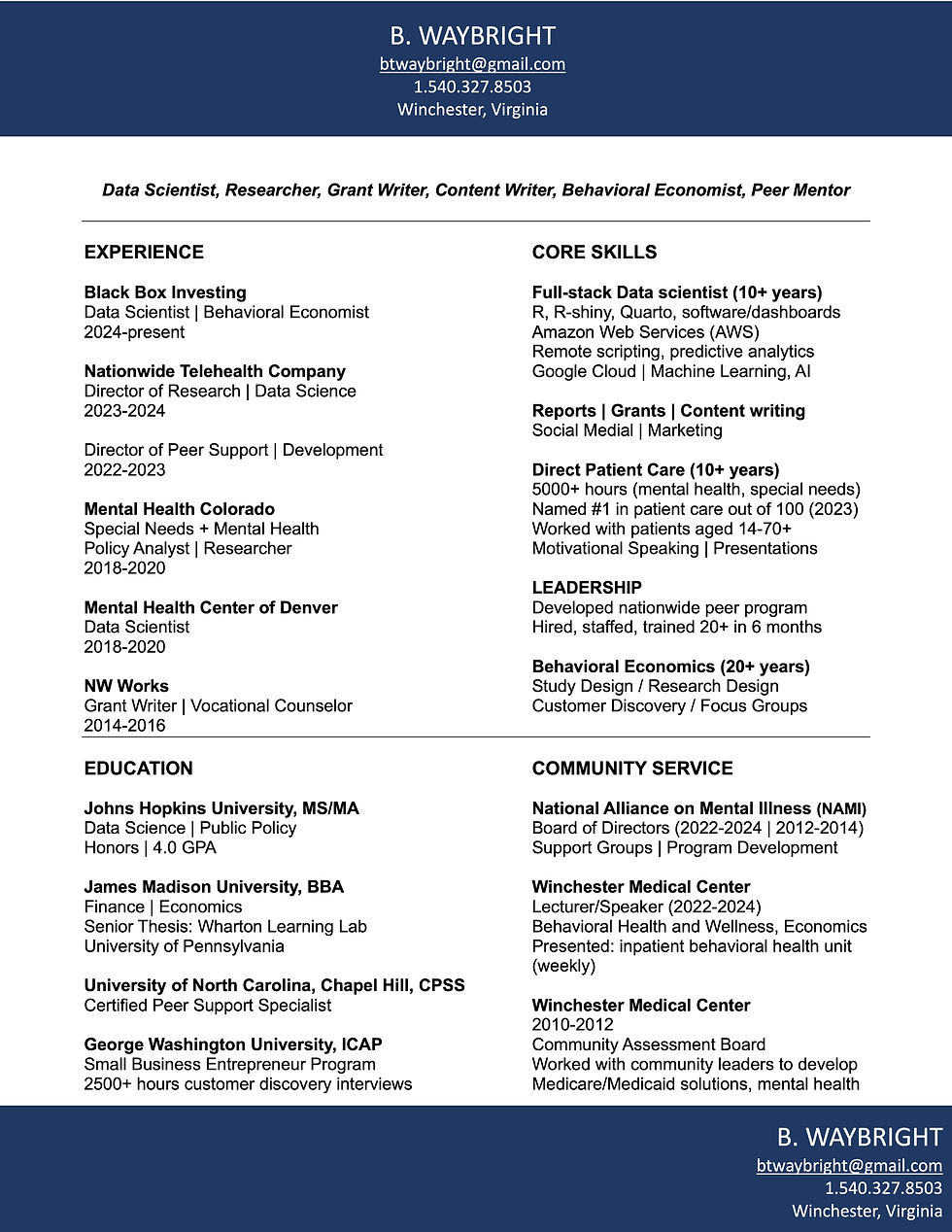
My name is B. I have more than 20 years cross-trained experience working in behavioral health care, program development, data science and research, public policy and behavioral economics, grant writing and marketing and direct patient care.
As a Social Security disability Beneficiary, I’m looking to re-enter the workforce this year in competitive employment, and our family is hoping you can help.
My Story of Hope
I was diagnosed with a cognitive brain disorder at the age of 23, and have more than 20 years lived experience overcoming bipolar disorder.
Many people think of bipolar disorder in clichés, where someone is happy one minute and sad the next. That’s simply not true.
Bipolar disorder is marked by longitudinal shifts in mood where people can be in life-threatening states of elation or psychosis for months or years at a time, or conversely in long-term states of depression—barely able to leave the house or engage in any type of work.
Both states present significant physical and mental health limitations. The unemployment rate among individuals living with bipolar disorder is between 40-60% or 10 to 15 times national averages, and bipolar disorder is one of the leading causes of disability in the United States.
As many as 1 in 5 or 20% of individuals living with bipolar disorder will lose our lives unexpectedly to suicide or overdose. More than half of us will attempt to take our own life at some point in our lives.
Immediately following my initial diagnosis, multiple mental health professionals told my parents that I would likely never move out of the house.
Today, I'm a homeowner, I live independently on my own. I have an 836-credit score, drive and shop for my own groceries, my only debt is my mortgage and by all accounts, I’m in good health.
It took years to get there.
As a child and throughout my twenties and thirties I worked to overcome selective mutism. It was a private internal battle, nobody really knew. Selective mutism is a disorder that limits your ability to communicate with anyone outside of your close friends and family. Bipolar disorder made it even more difficult and nearly impossible to maintain relationships and employment.
After more than a decade of unemployment, I was classified as disabled.
From 2014 to 2016, I worked part-time. Starting at a sheltered workshop with other disabled individuals, packaging milk and mowing grass for $7.25 an hour. Our family welcomed the job. It wasn’t much money, but it was everything, to our family.
The people I worked with and the staff were supportive and kind. I was promoted less than a year later to grant writer and paid $12 an hour, still working part-time. The continued support allowed me to find social and economic success.
I’m now able to have conversations and build relationships with almost anyone I encounter, and speak spontaneously as such.
In 2015, I helped draft a business plan that was used to start a café and bakery. The café operated as a sustainable business that also trained and employed fellow disabled members of our community.
Over subsequent years, the Governor of Virginia visited the site multiple times, praising the project’s innovation and impact on our small town.
In 2020, I completed graduate studies at Johns Hopkins University, finishing with a 4.0 GPA and a 98.2% grade average—with a concentration in public policy and data science and a research focus in behavioral economics.
As a disability and accommodations student, I only required testing considerations on one exam, a four-hour open-book test that took me 8 hours to complete on which I still only scored a 93%. It was a tough test.
In the summer of 2019, a professor commented on a final submission for a data science course I completed, noting, “this is by far the best paper I’ve graded as a Johns Hopkins University professor,” asking me to share my work and findings at conferences.
I wasn't quite ready for that yet. I thanked him graciously, and conveyed as such.
In early 2020, as Medicare and Colorado Medicaid limitations led to a lapse in my treatment, I was unable to fill key prescriptions, specifically lithium carbonate.
This lapse resulted in a prolonged psychosis episode. It took teams of mental health professionals from coast to coast to stabilize my condition over the next two years, to save my life. We lost the house in Denver and I lost a 10-year relationship. I eventually moved back home to Virginia to regroup, and stopped drinking alcohol altogether.
Earlier this year, I marked 5 years of sobriety.
In January 2022, I became a certified peer support specialist through the University of North Carolina, Chapel Hill. Over the next two years, I worked with patients at all income levels, from all walks of life, across the United States.
All with one common bond, a willingness to get better.
A peer support specialist is like a therapist, but their credentials are based on a combination of education, practicum and lived experience, often drawing from personal narratives and stories to help patients navigate early recovery.
Peer support specialists provide guidance to help patients define their own recovery goals and expectations, and are an essential component in early and sustained mental health recovery. Without the support of my own peer support specialists, all of whom overcame some form of bipolar or mental health disorder, I wouldn't be where I am today.
The reassurance that you're not alone, that others have experienced the same or very similar challenges, provides hope and recognition, that as a mental health patient, you can indeed overcome almost anything you put your mind to.
From March 2022-2024, I contributed to a nationwide tele-health start-up based in the mountain west. Over two years, we achieved success in multiple roles—building nearly 30% of the organization’s treatment program from the ground up, securing large long-term contracts, being named #1 in patient care when I served as Director of Peer Recovery and Life Coaching.
The latter part of my time was spent leading initial research, outcomes, and data science initiatives over my final 6 months. In early 2024, I stepped away from the project after two years to focus on more creative endeavors, and to focus more on my health.
From 2022 to 2024, while I was working in tele-health, I also served on the Board of Directors at the National Alliance on Mental Illness—where I taught courses at the Winchester Medical Center on behavioral health and wellness and economics—where I was hospitalized nearly a dozen times over 20 years.
Most patients who are hospitalized for mental health conditions are in states of acute depression, panic, trauma or psychosis. Many are dealing with persistent suicidal ideation—and most have experienced at least one suicide attempt prior to admission.
All are in need of behavioral health treatment—love, kindness, compassion and understanding. Which we were happy to give and receive back more than ten-fold most weeks.
TODAY—A Fellowship
Today, I'm seeking a research fellowship designed to support the business needs of any organization, and are more than open to stipend to start, that would position me along with your organization to write grants to fund joint-research and projects.
What is Song Health?
Song Health is a mental health and disability advocacy project aimed to improve health and economic outcomes for disabled Americans and their families.
Ideas
Conduct a feasibility study aimed to explore the cost benefit of increasing / ending income / earnings limits for Social Security Disability beneficiaries.
Disability beneficiaries earn on average at or below the federal poverty level. Earnings limits create barriers that keep disabled Americans in poverty, because disabled Americans are scared to work, for fear of losing their benefits. Thus, less than 1% of disability beneficiaries earn over the limits in a given year, with the remaining 99% paying zero dollars in taxes.
Our modeling suggests ending earnings limits actually saves America money, by increasing unrealized or unfound tax revenue, while decreasing other benefit program costs, while eliminating billions of dollars in administrative costs.
Conduct research that explores incentives for health networks and insurance companies for developing innovative treatment modalities for disabled patients. Where an insurance or health network is awarded tax credits or revenue based on patient success, meaning earnings or decreases in costs.
Develop a nationwide novel mental health treatment and jobs program for disabled Americans, one whose outcomes are incentivized by patient earnings.
Result
Over 10 years, disability in the United States could go from a trillion-dollar loss, to a surplus— with the right government policy, and through kind, compassionate and thoughtful application of behavioral and public choice economics.
So how you can help?
Too often, people think, well that's a great cause, I'm sure someone will help, and oftentimes, that’s not true.We encourage you to be the one who helps out.
Whether if it's a job interview (that would be amazing) or a soft employment opportunity where the hiring manager has our resume or a grant application that I can apply for, either as an individual or a small business or as an organization to co-apply for a grant.
Or even if it's just a kind word of encouragement, would be much appreciated. Send any and all our way. I am hoping to respond to every email, and can be reached at:
.
B. WAYBRIGHT
RESUME